
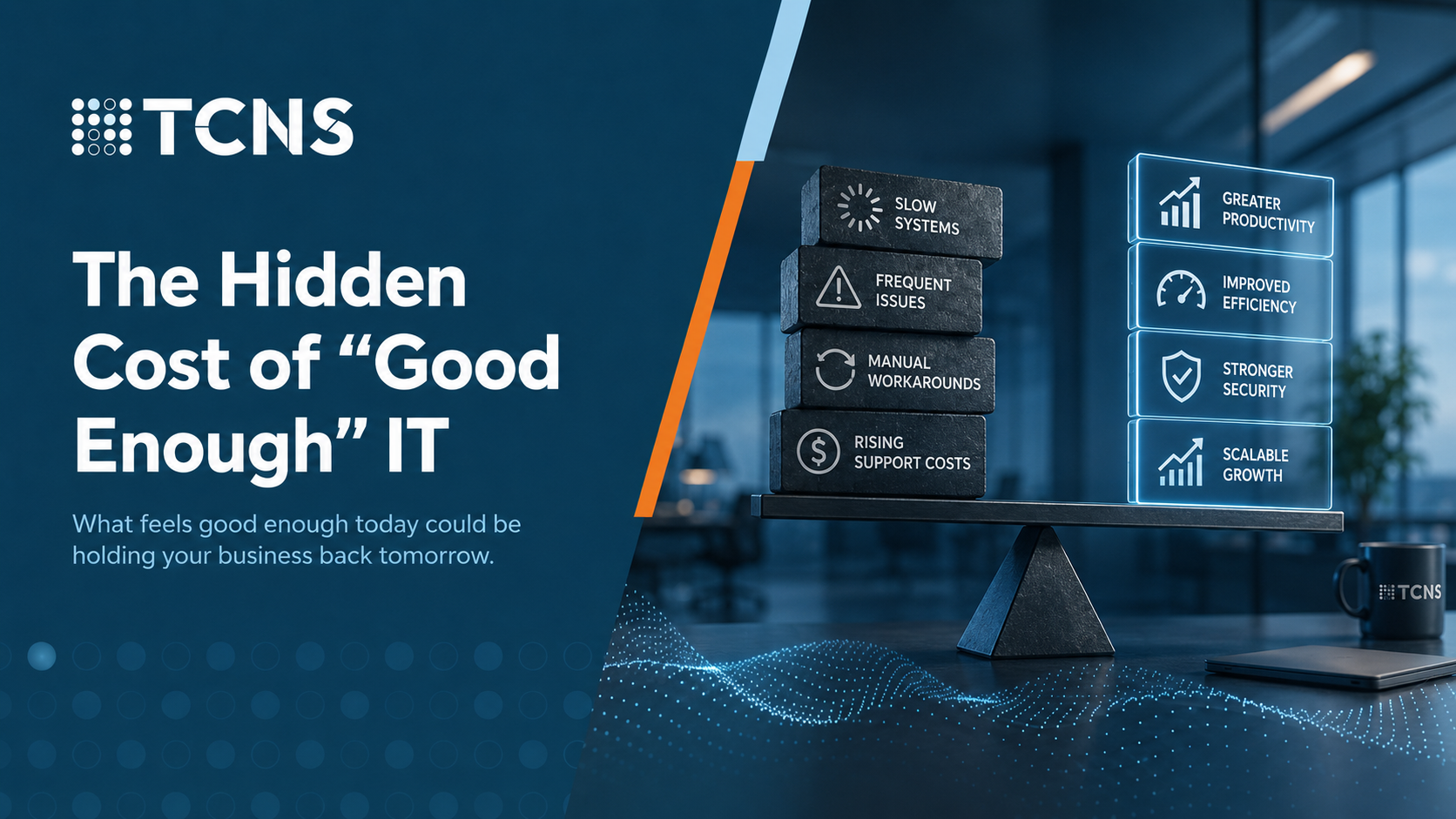
For many SMEs, IT falls into a familiar category: good enough.
Systems work, most of the time. Staff can access what they need. Issues get resolved eventually. On the surface, there is no obvious reason to change.
But beneath that surface sits a growing problem.
“Good enough” IT rarely stays good enough for long.
The Illusion of Stability
When systems are not failing outright, it creates a false sense of security. Leadership teams assume the environment is stable, when in reality it is often under strain.
Small inefficiencies begin to appear. Systems slow slightly. Support tickets increase. Workarounds become normal.
Individually, these issues seem manageable. Collectively, they represent a drag on the business.
The Hidden Cost of Inefficiency
Time lost to slow systems, repeated issues and manual processes is rarely measured, but it is significant.
Employees waiting for applications to load, reconnecting to systems or chasing recurring problems are not operating at full productivity.
Over time, this impacts output, morale and ultimately profitability.
Why Problems Keep Returning
In many environments, IT support focuses on resolving issues as they arise rather than addressing root causes.
This creates a cycle where the same problems return repeatedly.
Breaking this cycle often requires stepping back and reviewing the wider environment, something typically aligned with IT Consultancy Services.
Infrastructure Often Falls Behind
As businesses grow, their reliance on technology increases. However, the underlying infrastructure does not always evolve at the same pace.
This can lead to performance bottlenecks, reliability issues and limitations when adopting new tools or systems.
These challenges often sit within Network Infrastructure Services, where switching, cabling and overall design play a critical role.
Security Risks Increase Over Time
Outdated or poorly maintained environments can also introduce security risks.
Gaps in patching, visibility and control can expose organisations to threats that are not immediately obvious.
Addressing these risks requires alignment with Cyber Security Services, ensuring protection evolves alongside the business.
The Cost of Delayed Decisions
One of the biggest risks with “good enough” IT is delay.
Decisions are postponed because systems still function, even if they are not performing optimally.
This often leads to larger, more expensive projects later, rather than controlled, incremental improvements.
The Leadership Perspective
IT should not be viewed purely as a cost centre. It is an enabler of productivity, efficiency and growth.
When technology performs well, it supports the business. When it does not, it quietly holds it back.
Ongoing optimisation and performance management are typically delivered through Managed IT Services, ensuring systems remain aligned with business needs.
Final Thought
“Good enough” IT is rarely neutral. It either supports the business or it limits it.
Over time, small inefficiencies compound into meaningful cost and lost opportunity.
The organisations that perform best are not those with the most technology, but those where technology is properly aligned, maintained and continuously reviewed.

